Tracing the loop before condemning the board
Fault-finding on engine-room monitoring and alarm systems starts at the loop, not the cabinet. Loops are traced end to end — sensor, wiring, module — before any board is condemned, because a control card is the most expensive part of the circuit and the least likely to have failed.
A repeating alarm with no corresponding fault is usually a sensor drifting out of calibration or a termination that has gone high-resistance. Both read as a module fault from the alarm list alone, which is why the reading is taken at the sensor and again at the input card rather than inferred from the screen.
Scope of work
Alarm & monitoring loop fault-finding
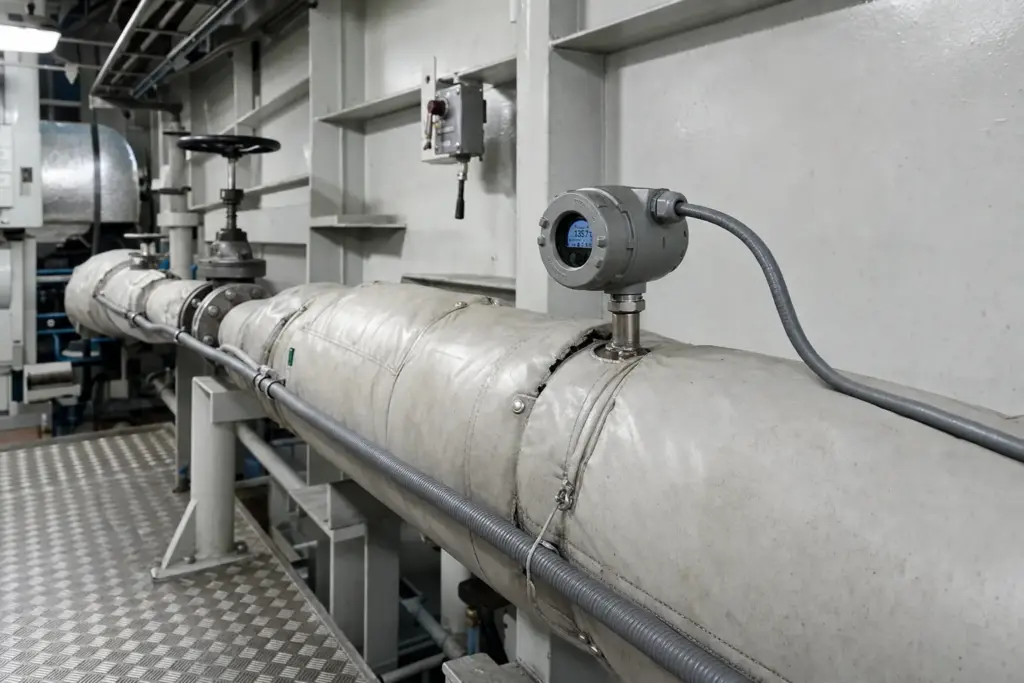
Loops traced from sensor to input card, with the reading taken at both ends rather than read off the alarm list.
PLC and I/O module replacement
Modules replaced and configured once the loop has been proven, not as a first step.
Sensor & transmitter calibration
Transmitters checked against a known reference and recalibrated where they have drifted.
Engine-room monitoring networks
Network integrity, supply and termination checked across the monitoring backbone.
Pump & compressor starter logic
Starter, interlock and control logic verified against the scheme, including auto-changeover behaviour.
As-built drawing updates
Drawings corrected to match what is actually installed, so the next engineer is not working from fiction.
Attendance sequence
| Phase | Stage | Actions and deliverables |
|---|---|---|
| 01 | Measured readings | Loop readings taken at the sensor and at the input card, plus insulation and supply values per circuit. |
| 02 | Photo record | Before and after each cabinet opened or termination made, timestamped. |
| 03 | Parts & work list | Modules replaced, sensors recalibrated, logic adjusted — and what remains outstanding. |
| 04 | Recommendations | Defects found but not addressed, with a priority against the next docking, and drawings corrected to match the installation. |
What is measured
A loop is proven from both ends before a module is replaced. Every reading is logged against the loop it came from.
Where this work is carried out
Vessels attended in port or at anchor across the North Adriatic, including the commercial quays at Koper.