How a control fault is traced
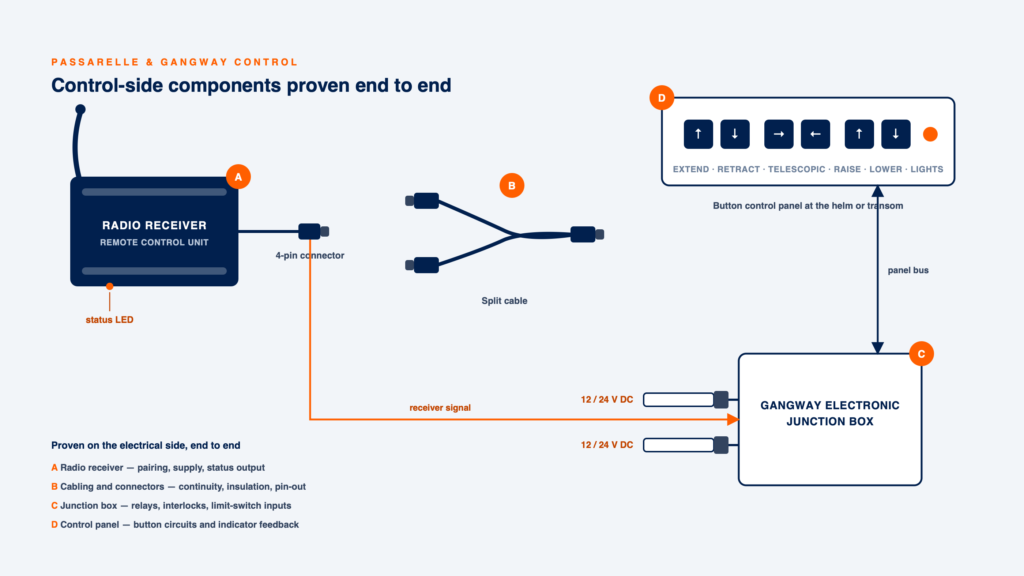
On a remote-controlled passarelle, a single movement lost while the others still operate indicates a control fault rather than a hydraulic one, since a failed pump or ram affects every function. The fault is isolated to the control board output for that movement, its limit switch, or the solenoid that operates it. Each movement is followed through the board, input and output, from both the handset and the panel, before any component is replaced.
Testing is carried out at the berth with the vessel afloat and berthed stern-to, which is the condition the system operates in. Travel, end stops and interlocks are run against the quay at working angle and from both the remote and the panel, because a unit that cycles correctly unobstructed can still stop short under the angle and load it meets in service.
Scope of work
Remote control receivers & handsets
Receivers, aerials and handset pairing checked where a remote-controlled passarelle answers intermittently, at close range only, or not at all — including the supply to the receiver, which is a more common cause than the handset itself.
Control board & relay sequencing
Each movement followed through the board input by input and output by output, so a function that receives its command but never energises is separated from one that was never commanded.
Limit & proximity switches
Stowed, deployed and end-of-travel switches tested individually — a single failed switch stops travel in one direction and leaves every other movement working normally.
Lock, release & swivel solenoids
Coil resistance and holding voltage measured at the solenoid itself, which separates an open coil from a supply that collapses under load.
Tread lighting & call points
Passarelle lighting, courtesy strips and any call or intercom point on the boarding position, all of which sit on circuits that get wet and are usually the first to corrode.
Tender garage & hatch interlocks
Interlock chains proven end to end and emergency manual overrides confirmed to release under load — tested rather than assumed, since that is the circuit that matters when the powered one has failed.
Attendance sequence
| Phase | Stage | Actions and deliverables |
|---|---|---|
| 01 | Symptoms by message | Vessel, berth, and which movements still work — the ones that do narrow the fault faster than the one that does not. Whether it fails from the remote, the panel or both. |
| 02 | Berth-side diagnostic | Control board followed input to output for each movement, limit and proximity switches tested individually, solenoid coils and motor current measured under load. |
| 03 | Written plan | Which circuit or component is at fault, what is repaired against what is replaced, and the manual override procedure in the meantime. Where the fault is hydraulic or structural, it is handed back as such. |
| 04 | Work, test, document | Circuits repaired, then every movement and both end stops run through their full travel from remote and panel, with the emergency override tested last. Readings and photographs issued. |
What is measured
A passarelle fault is confirmed as electrical, or handed back as mechanical, on readings taken while the system is live and under load. A control circuit that reads clean at rest says very little about one that fails part way through a movement.
Where this work is carried out
Attended at the berth across the North Adriatic, including the ACI marinas at Umag, Rovinj and Pula where stern-to berthing is standard.