Skip to content
Mon–Fri 08:00–17:00
Hospitality & facilities

Galley & laundry equipment repair

Element, contactor and control faults on ovens, dishwashers, dryers and washers — what is repairable at the machine and what needs a part ordered.

3-phase 400 V Combi ovens Dishwashers & laundry Cold room controls
400 V Three-phase distribution & machinery
Out of hours Work scheduled around service periods
Component-level The part is replaced, not the machine
Records kept Readings logged per board tested

Why the appliance is usually not the problem

Heavy-duty catering equipment fails on elements, contactors and controls long before the machine itself is worn out. The failed component is identified and replaced rather than the appliance — a combi oven that trips the board on heat-up is an element or contactor fault far more often than it is a dead oven.

Most of these faults are only visible under load and at temperature, which is the condition a kitchen cannot easily create during service. Inspection and preventive work is therefore booked into periods when the equipment is cold and out of use, and reactive faults are worked around service periods.

Scope of work

Combi oven element & contactor service

Element continuity, contactor condition and control faults on ovens that trip on heat-up.

Dishwasher and booster heater faults

Booster heater, thermostat and control diagnosis where a machine will not reach rinse temperature.

Induction hob & power module testing

Power module and supply testing on hobs that cut out under sustained load.

Extraction fan and interlock wiring

Interlock circuits traced where an extraction fault is stopping the burners.

Cold room & compressor controls

Control, thermostat and starter faults behind short-cycling compressors.

Thermostat and probe calibration

Probes checked against a reference and recalibrated where readings have drifted.
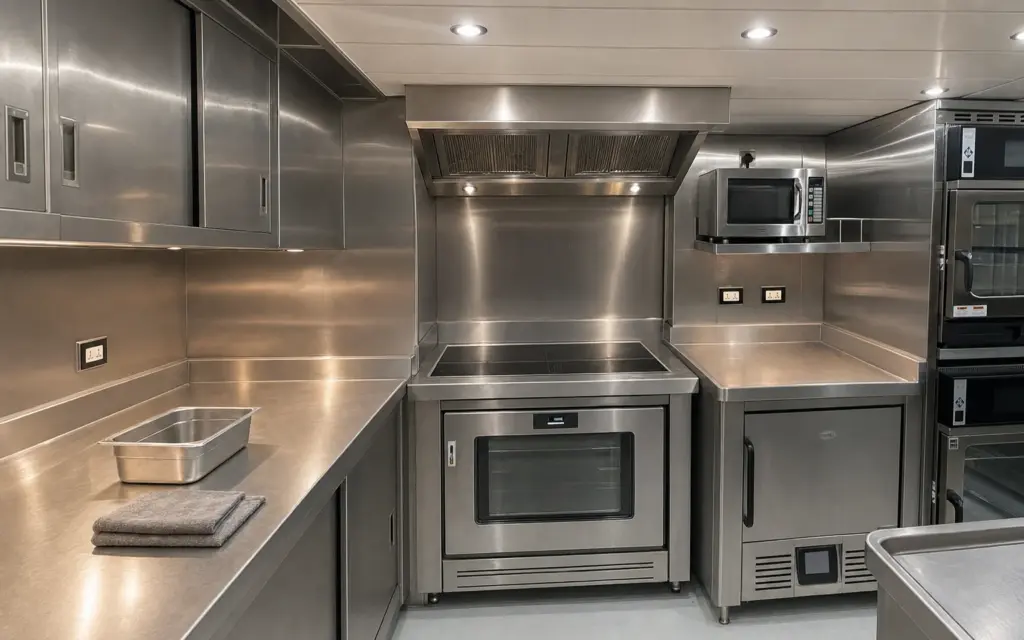
Stainless combination steam oven in its galley housing beneath an induction hob, extraction canopy and grease filters above, worktops clear except for a gastronorm container and a folded cloth

How the work is scheduled

PhaseStageActions and deliverables
01 Pre-season, March to May Full board inspection, thermal survey, generator test run, and equipment brought up to service condition before the season opens.
02 In-season, June to September Reactive faults only, worked around service periods — early morning and late-night attendance so a kitchen is not taken down mid-service.
03 Post-season, October to November Strip-down and repair of equipment flagged during the season, with parts ordered against the written list.
04 Records Readings logged per board tested, so the following pre-season inspection compares against a baseline.

What is measured

Catering equipment faults are found under load and at temperature. Readings are taken per board and per machine, not per site.

Load current per phase
True RMS under working load, which is where an unbalanced three-phase supply or a failing element shows itself.
Thermal survey
Distribution boards, contactors and terminations scanned under load — a contactor on its way out runs hot long before it fails.
Insulation resistance
Measured on machine circuits, where steam, cleaning water and heat degrade insulation fastest.
Probe and thermostat accuracy
Checked against a known reference, because a machine that will not reach temperature is often reading it wrongly rather than failing to make it.

Where this work is carried out

Coastal hotels, resorts and commercial kitchens across Istria and the Gulf of Trieste.

Croatia Pula, Rovinj, Vrsar, Poreč, Umag, Novigrad
Slovenia Izola, Koper, Portorož
Italy Trieste, Muggia

Questions asked most often

The combi oven trips the board on heat-up — does it need replacing?
Usually not. Tripping on heat-up points at an element or a contactor rather than the oven. The failed component is identified and replaced; the machine is generally sound.
The dishwasher will not reach rinse temperature — what is checked first?
The booster heater, its contactor and the thermostat or probe. A machine reading temperature wrongly behaves exactly like one that cannot reach it, so the probe is checked against a reference before parts are ordered.
Can work be done without closing the kitchen?
Reactive faults are worked around service periods, with early morning and late-night attendance. Inspection and preventive work is booked into pre- or post-season, when equipment is cold and out of use.
Why does the pool pump trip the RCD in the morning?
A pattern that appears at one time of day usually means moisture or condensation raising leakage on a circuit that is otherwise sound. It is measured on the circuit under load rather than resolved by resetting.

Facility inspection scheduling

Send the site, the equipment involved and your service hours. Planned work is scheduled into a window where the equipment is cold.

WhatsApp