Skip to content
Mon–Fri 08:00–17:00
Yacht & leisure electrical

Watermaker electrical & controls

Supply and starting current for the high-pressure pump, control board, salinity probe and flush circuits. Electrical scope; membranes and pump hydraulics are not serviced.

Reverse osmosis HP pump supply Inrush current Flush & salinity control
55–70 bar Typical seawater RO pressure
Up to 7 × Starting vs running current
Under start Measured as the pump cuts in
Electrical Membranes not serviced

Why yacht watermakers trip the inverter on starting

A watermaker is usually the largest step load on board. The high-pressure pump does not ramp up — it arrives all at once, and for a fraction of a second it draws several times the figure printed on the data plate. An inverter or breaker chosen against the running current will carry the unit perfectly well once it is turning and still trip every time it starts.

That is why the measurement is taken at the moment of starting rather than at rest. Voltage at the pump terminals as it cuts in, the length and condition of the run feeding it, and what the inverter or generator can actually deliver into a step load are what decide the fault — not the steady-state reading, which will usually look fine.

Scope of work

Supply sizing & electrical installation

Feed and high-pressure pump loads measured against what the bank, inverter or generator can deliver, then the supply, breaker and control wiring installed to suit the run length actually on the vessel.

Starting inrush current analysis

Inrush captured as the pump cuts in, to establish whether the inverter, the breaker or the cable run is the limit.

Control board & relay diagnostics

Start and stop logic, interlocks and relays traced circuit by circuit to find why a unit will not run, or will not stop.

Salinity sensor & diverter valve circuits

Conductivity probe, its wiring and the diversion valve circuit tested when product water is sent to waste continuously.

Fresh-water flush system wiring

Flush solenoid, its timer and their supply checked as one circuit — the one most often found dead after a winter layup.

Pressure & flow safety switches

Low-pressure and flow switches tested individually, including the dry-run protection that will stop a unit starting at all.
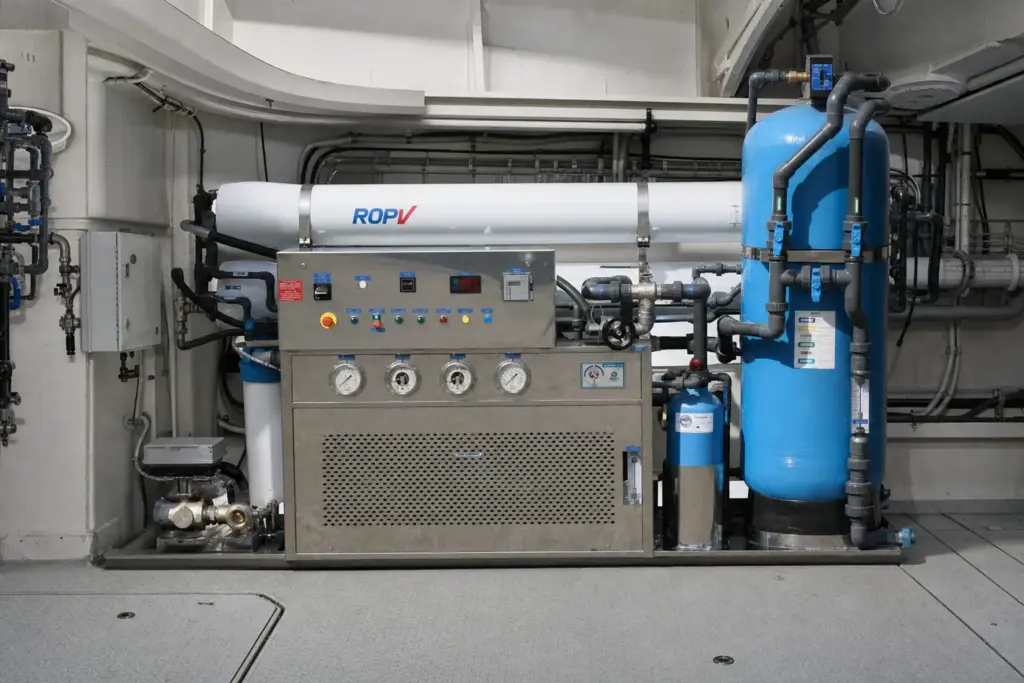
Reverse-osmosis watermaker skid in a vessel machinery space: control panel with gauges, pressure vessels and pipework, deck plating and cable runs behind.

Attendance sequence

PhaseStageActions and deliverables
01 Symptoms by message Vessel, berth, and whether it fails on starting, in service or on flush — plus whatever the control panel displays when it does.
02 Berth-side diagnostic Voltage at the pump terminals measured as it cuts in, starting current captured, and the control, probe and flush circuits traced individually.
03 Written plan Which circuit is at fault, what is repaired against what is replaced, and whether the limit is the supply or the unit itself. Where the fault is hydraulic, it is handed back as such.
04 Work, test, document Circuits repaired, the unit run through a full cycle including flush, readings and photographs issued.

Measurement and method

A watermaker fault is confirmed as electrical, or handed back as mechanical, on readings taken while the unit runs. Every measurement below is taken under power — a circuit that reads clean at rest tells you almost nothing about one that fails on starting.

Voltage at the pump, on starting
Measured at the motor terminals at the instant it cuts in, which is where an undersized run or a tired termination shows itself and nowhere else.
Starting current
Inrush captured on start and compared against what the inverter, breaker or generator feeding it is actually rated to deliver into a step load.
Control circuit continuity
Start and stop logic, interlocks, pressure and flow switches traced one at a time rather than diagnosed by swapping parts until it runs.
Probe and flush circuits
Conductivity probe and flush solenoid tested at their own terminals, which separates a sensor or wiring fault from a genuine water-quality result.

Where this work is carried out

Delivered at the berth or in the yard across the North Adriatic.

Croatia Pula, Rovinj, Vrsar, Poreč, Umag, Novigrad
Slovenia Izola, Koper, Portorož
Italy Trieste, Muggia

Questions asked most often

Why does the watermaker trip the inverter on starting but run fine once it is turning?
Starting current is several times running current for a fraction of a second. An inverter sized against the running figure will carry the unit once it is turning and still trip on the step every time it cuts in. The inrush is measured at the moment of starting and compared against what the inverter can actually deliver.
Do you service watermaker membranes or high-pressure pumps?
No. The scope here is electrical and control: supply and starting current, the control board, and the probe, flush and switch circuits. Membrane replacement, chemical pickling and pump hydraulics are a separate trade. Where a fault turns out to be mechanical it is identified as such and handed back, rather than worked on.
Why is the watermaker running but diverting all the fresh water to waste?
The diversion valve holds product water to waste until conductivity comes into specification. A fouled or miswired probe, or a failed valve circuit, will hold it there regardless of how good the water actually is. Probe and valve circuits are tested at their own terminals to separate a sensor fault from a real water-quality result.
What causes the fresh-water flush to fail after winter layup?
The flush solenoid and its timer usually sit on a circuit that gets isolated for the winter and is not always restored. Solenoid, timer and supply are checked together as one circuit, since a flush that silently does not run leaves the membrane sitting in seawater between uses.

Request a berth-side diagnostic

Send vessel, berth and fault symptoms. Attendance across Istria and the Gulf of Trieste is scheduled by arrangement once the fault has been assessed.

WhatsApp