Skip to content
Mon–Fri 08:00–17:00
Yacht & leisure electrical

Shore power & 230 V

Isolation transformers, RCD tripping, galvanic isolation and earth-fault tracing.

230 V AC RCD tripping Galvanic isolation Earth-fault tracing
30 mA Marina RCD threshold, to 63 A
IEC 60309-2 CEE shore connectors
IP44 Minimum connector rating
Under load Measured with the shore lead connected

Why the fault only appears on the pontoon

Marina trips, earth faults and voltage drop are measured under load with the shore lead connected. That is the only condition in which most of these faults appear — a circuit that reads clean at rest will still trip a pedestal the moment the vessel draws current.

Marina socket-outlets up to 63 A are individually protected by a residual current device rated at 30 mA or less, disconnecting all poles including neutral. Earth leakage that is harmless from any one appliance adds up across a whole vessel, so a boat that trips the pedestal is usually carrying several small faults rather than one large one.

Scope of work

230 V shore power & isolation

Shore inlet, isolation transformer and changeover arrangements, wired and tested with the lead connected.

RCD tripping diagnosis

Leakage measured circuit by circuit under load, to find which appliances contribute and by how much.

Galvanic isolation & corrosion

Galvanic isolator or isolation transformer specified and fitted, with the safety-earth path verified intact.

Earth-fault & voltage-drop tracing

Insulation resistance and voltage drop traced across the AC path from inlet to the furthest outlet.

Bilge pump & float switch circuits

Pump, float and alarm circuits tested — including a pump cycling with no water aboard, which is usually a float or wiring fault.

Panel rebuild & circuit labelling

AC panels rebuilt with correct protection and a documented circuit schedule replacing unlabelled legacy fusing.
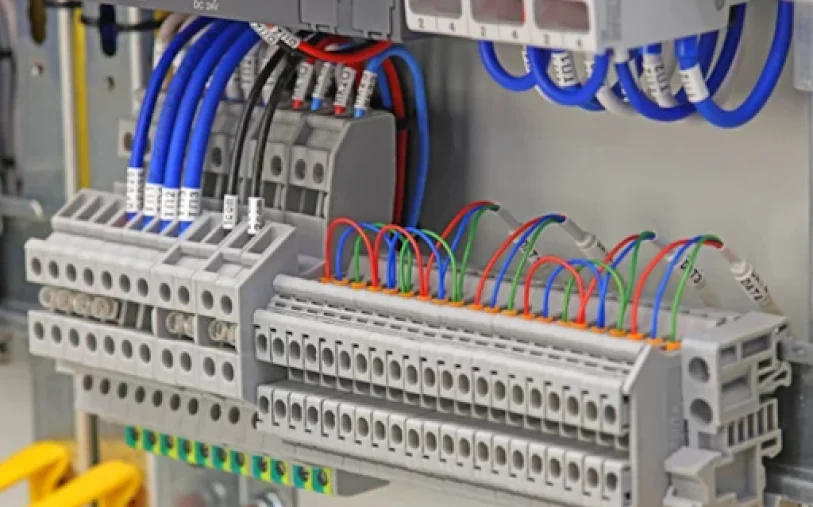
Terminal blocks and wiring inside a control enclosure

Attendance sequence

PhaseStageActions and deliverables
01 Symptoms by message Vessel, berth, which pedestal, and the trip pattern — on connection, under galley load, or intermittently overnight.
02 Berth-side diagnostic Leakage measured circuit by circuit with the lead connected and the vessel under load, plus insulation resistance and voltage drop across the AC path.
03 Written plan Which circuits contribute what leakage, what is repaired against what is replaced, and whether an isolator or a transformer suits the berth.
04 Work, test, document Repairs made, protection verified, vessel reconnected and re-tested under load, readings and photographs issued.

Measurement standards

Marina supply follows HD 60364-7-709 (marinas and similar locations) — transposed as HRN HD 60364-7-709 in Croatia, SIST HD 60364-7-709 in Slovenia and CEI 64-8/7 Sezione 709 in Italy.

Residual current protection
Every marina socket-outlet up to 63 A is individually protected by a residual current device of 30 mA or less, disconnecting all poles including neutral. In Italy, outlets above 63 A move to a 300 mA threshold.
Shore connectors
Socket-outlets up to 63 A comply with IEC 60309-2 — blue 2P+E for 230 V single phase, red 3P+N+E for 400 V three phase — to a minimum of IP44.
No PEN conductor to the vessel
On a TN supply the final circuit to a pleasure craft must not include a combined protective-and-neutral conductor. Protective earth and neutral stay separate from the pedestal onwards.
Isolation and the earth path
An isolation transformer provides protective separation from the shore supply; a galvanic isolator blocks DC on the protective earth while passing AC. Either way, the safety-earth path must remain intact if the device fails.

Where this work is carried out

Delivered at the berth or in the yard across the North Adriatic. The marina wiring rules are harmonised across the three countries, with the national variations noted above.

Croatia Pula, Rovinj, Vrsar, Poreč, Umag, Novigrad
Slovenia Izola, Koper, Portorož
Italy Trieste, Muggia

Questions asked most often

Why does shore power keep tripping the marina RCD?
The pedestal device trips at 30 mA or less, and earth leakage adds up across every appliance aboard. A vessel that trips on connection is usually carrying several small leakage faults rather than one obvious one, which is why leakage is measured circuit by circuit under load rather than guessed at.
Isolation transformer or galvanic isolator?
A galvanic isolator blocks DC on the protective earth and is the cheaper option. An isolation transformer separates the whole AC circuit and re-references the neutral aboard, which also removes cross-border polarity differences. For a mixed-metal hull on a long-term berth we recommend the transformer — that is an engineering judgement, not a requirement of the standard.
Can the shore earth be disconnected to stop corrosion?
No. Whichever isolation device is fitted, the safety-earth path must remain intact if that device fails. Breaking protective earth to solve a corrosion problem creates a more serious one.
The bilge pump runs with no water aboard — is that the pump?
Usually the float switch or its wiring rather than the pump itself. The float, its circuit and the alarm path are tested before a pump is replaced.

Request a berth-side diagnostic

Send vessel, berth and fault symptoms. Attendance across Istria and the Gulf of Trieste is scheduled by arrangement once the fault has been assessed.

WhatsApp