How commissioning and calibration are carried out
Autolearn tunes rudder response — how much helm the pilot applies and how quickly it takes it off again. It does not correct heading. A pilot holding a steady course that is off the one requested has a compass deviation or sensor alignment fault, which autolearn will not address. The two corrections are separate procedures and are carried out separately; treating them as one is a common reason a pilot is reported as faulty after a calibration that appeared to complete.
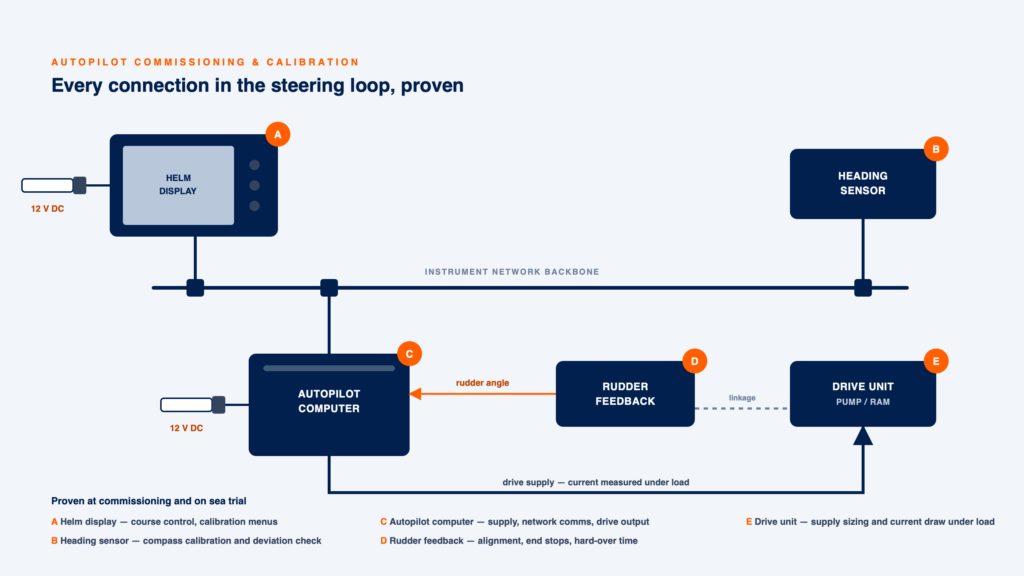
Approximately half of commissioning is completed at the dock: drive type, rudder travel limits, hard-over time from lock to lock, the rudder feedback centre and its end stops, and a follow-up test confirming that the drive and the feedback agree on direction. Only the compass swing and the response tuning require sea room. Completing the dockside stage first is what avoids running the sea trial twice.
Scope of work
Dockside commissioning & rudder limits
Drive type, travel limits and hard-over time from lock to lock set at the berth, along with the play in the steering the pilot has to work around.
Rudder feedback alignment & polarity
Feedback unit zeroed at dead ahead and its end stops set, then a follow-up test run to prove drive and feedback agree on direction before anything goes to sea.
Heading sensor alignment
Solid-state sensors aligned to the vessel’s centreline, which decides whether the pilot steers the heading it is asked for or one a few degrees off it.
Compass deviation swing
Run under way in flat water, slowly through rather more than a full circle, and repeated where the automatic routine will not complete — a manual correction is the fallback, not a failure.
Response tuning & sea trial
Rudder gain and counter-rudder tuned under way against how the vessel actually behaves, loaded and trimmed as she is used rather than as she left the yard.
Sensor siting & interference
Heading sensors relocated where they sit near pumps, motors or the engine — a compass that will not swing cleanly is usually mounted somewhere it never should have been.
Attendance sequence
| Phase | Stage | Actions and deliverables |
|---|---|---|
| 01 | Symptoms by message | Vessel, berth and what the pilot actually does — wanders, will not engage, holds a steady but wrong heading, or hunts. Each points somewhere different before anyone attends. |
| 02 | Dockside setup | Drive and rudder limits set, feedback zeroed and its end stops confirmed, and the follow-up test run so drive and feedback are proven to agree before the lines come off. |
| 03 | Sea trial | Compass swung in open water and response tuned against how the vessel handles under way. Weather is chosen for it — a swing attempted in a chop will not complete and gets blamed on the equipment. |
| 04 | Work, test, document | Pilot run on a settled heading and through several course changes to prove it holds, with the settings arrived at, the readings and photographs issued. |
What is measured
A pilot is proven on the water, on figures rather than on how it feels. Every setting below is recorded, so the next person to touch it knows what it was set to and why.
Where this work is carried out
Dockside setup at the berth across the North Adriatic, with the sea trial run from the vessel’s own marina in settled weather.